What does the latch score mean in SHARP ratings?
It was great to meet so many riders in person at the Motorcycle Live event last November. One question we were repeatedly asked was: What does the latch score mean?
For flip-up or modular helmets, next to the star rating, SHARP displays a number as a %. This is the latch score. It is an indicator of the effectiveness of the mechanism that keeps the chin guard closed following an impact.
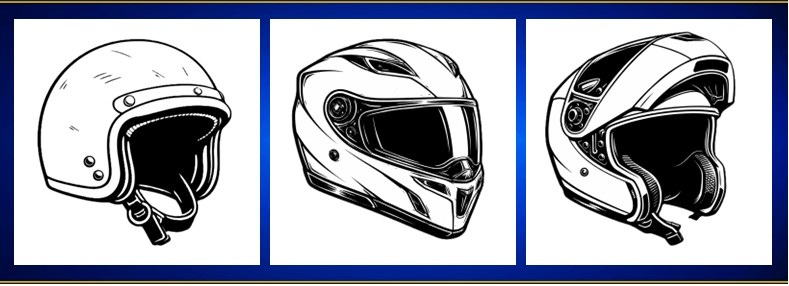
Let’s back up a moment. There are three main types of helmet:
- Open-face helmets expose the wearers eyes, nose, teeth and chin. Half-helmets, bucket helmets and ¾ helmets also fall into this category.
- Full-face helmets cover the chin and teeth, and protect the nose and eyes. Off-road and sport helmets are generally full-face helmets.
- System/modular/flip-up helmets have a lower face guard covering the chin and mouth which can be raised above the forehead.
For system (modular/flip-up) helmets, the big question is: ‘In a crash, will the chin guard spring open and expose my face?’
When new flip-up helmet designs are submitted for approval, to get the ticket that says the design meets ECE 22.06 standards, a series of specific tests are conducted against the protective chin guard which examine its strength, retention effectiveness, and impact protection when in its “closed” or “down” position. But no tests are conducted in relation to the mechanism that keeps it locked in place.
The SHARP scheme is all about giving consumers information to help them make purchasing decisions about helmets. SHARP complements the ECE 22.06 tests. We observe and record what happens to the chin guard during the SHARP impact testing process. This is the basis of the latch score.
Every test we conduct at SHARP is recorded by a high speed camera so that we can see exactly what happens to a helmet when we drop it. In the clips below you can see how much the helmet is deformed on impact and why an impact at speed puts so much stress onto to the mechanism that keeps the chin guard locked.
The percentage score relates to the number of times the lower face guard stays fully locked during testing. (See below for the formula).
The latch score is provided to consumers as a separate piece of information about a helmet, to help riders assess whether a flip-up helmet is suitable for them. It may be helpful to think of the % number as a measure of reliability of the chin guard locking mechanism. So to help interpret the % score:
- If SHARP has tested the helmet and it has a 100% latch score, this provides a high level of confidence that the helmet chin guard will stay locked after an impact. It isn’t a guarantee, but it is a really strong indicator of latch reliability.
- If the latch score is 70% – 99%, this information tells you that the helmet has the potential to open in a collision. This score reflects doubt about the reliability of the latch mechanism.
- If the latch score is around the 50% mark, then it is like a coin toss. You might get lucky, or you might not. You can still be sure that the helmet will provide good protection for your brain, but there is now a 50% chance that your face may be exposed in a crash.
At SHARP we have seen and reported flip-up helmets with very low latch scores under 20%. This is definitely cause for concern. Our tests don’t reveal why a chin guard has opened. Hopefully the manufacturers take heed of our observations and act to improve the reliability of the helmet’s latch mechanism.
The protective value of any helmet starts with it being a good fit, so SHARP recommends that this is the main criteria for selecting a helmet. If you have a choice of helmets that are also comfortable and have the features you prefer, then the latch score provided by SHARP is an additional piece of information about a helmet to help you make an informed choice.
How the % latch score is calculated
The % score indicates how often the helmet’s lower face cover remains fully locked after each one of 30 impact tests at different speeds. This is the formula:

This translates as:
- If the chin bar stayed locked in all 30 tests → 100% latch score
- If it opened in 9 tests → 70% latch score
The SHARP star rating for a helmet is an objective assessment of the helmet’s ability to protect against head injury. The performance of the chin guard locking mechanism (the latch) during testing is not included in the calculations for a SHARP star safety rating because there is no objective measure of the safety effect of latch failure. Similarly, we are unable to quantify the safety difference between a helmet that achieves a latch score of, say, 63% and one that achieves 90%; clearly though, the risk of facial injury increases with lower latch reliability.