Does SHARP work? YES, it does!
Improvements in motorcycle helmet safety performance over time
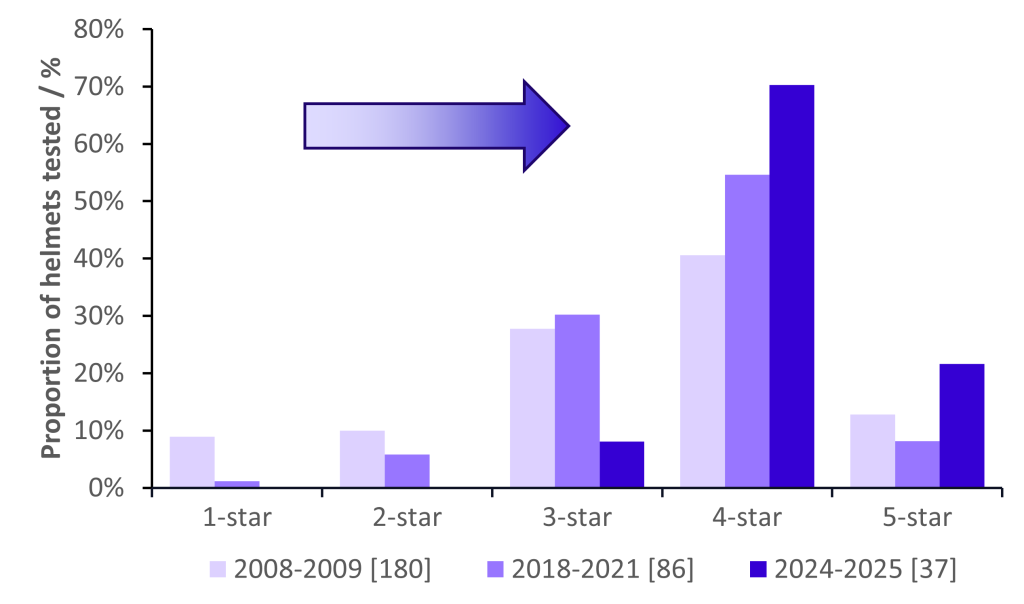
SHARP has now tested over 50 helmets which meet the new UNECE Regulation 22.06 (R22.06) motorcycle helmet type approval regulations. What we have learned about the effect of the helmet safety assessment scheme is illustrated neatly in the graph above.
Looking back over the past 18 years of testing 600+ motorcycle helmets, and taking a snapshot of test results at three points in time:
- The initial years of testing raised the profile of safer helmet model designs that could achieve 3, 4 and 5 stars, whilst identifying poorer designs on the UK market that didn’t protect riders as well (good helmet designs featured rigid shells and energy absorbing crushable inner layers).
- Manufacturers responded to this by removing poorer performing helmet models from helmet ranges and developing more protective helmet designs. We can see the impact of this in the 2018-2021 data, where a much greater proportion of helmet models achieved a 3, 4 or 5 star rating than during the initial years of testing, with this mainly driven by better safety performance at SHARP’s higher impact speed tests (8.5 m/s).
- After 2024, where all new helmets entering the UK market were required to comply with R22.06 – which now has a higher impact test speed of 8.2 m/s – SHARP is seeing a substantial shift in helmet safety performance. This has resulted in the vast majority of R22.06 compliant helmets tested so far achieving a 4 or 5 star rating.
So what difference does this trend in improving motorcycle helmet safety really mean? Well, for exactly the same set of collision loads to a rider’s helmet, where previously riders had a 60-80% chance of sustaining a serious/severe head injury if had they purchased a 1 star helmet model, riders now have a 60-80% chance of receiving only a slight head injury if they buy a 5 star helmet model. The difference is walking away from a crash with mild concussion, versus a week in intensive care and potentially life limiting repercussions. With so many riders now choosing to wear R22.06 certified helmets, the benefits are clear.
Crucially, SHARP continues to observe no correlation between helmet model price and SHARP star rating. Among the R22.06 helmets tested so far, 5 star rated helmets have been available to buy in all price ranges: from budget helmets for moped riders, through to high end helmets for professional riders.
Surprisingly, SHARP is still finding new R22.06 helmets that only achieve a SHARP 3 star rating. These are perfectly legal, but there is definitely a higher risk associated with wearing such a helmet model. Only a SHARP star rating can identify and quantify these risks between helmet designs for riders.